Try scrolling the rest of the page to see this option in action.
Analyse en cours...
Analyse du texte en cours...
Teaching & Learning Technology
Teach and learn through problems, projects, and prototypes.
Reserve your institution’s space
Free, no credit card: start with your email address.
Free Discovery workspace, no payment card required. A verified academic or professional email address is required to create a workspace. No sign-up required: immediate access to a demonstration space.
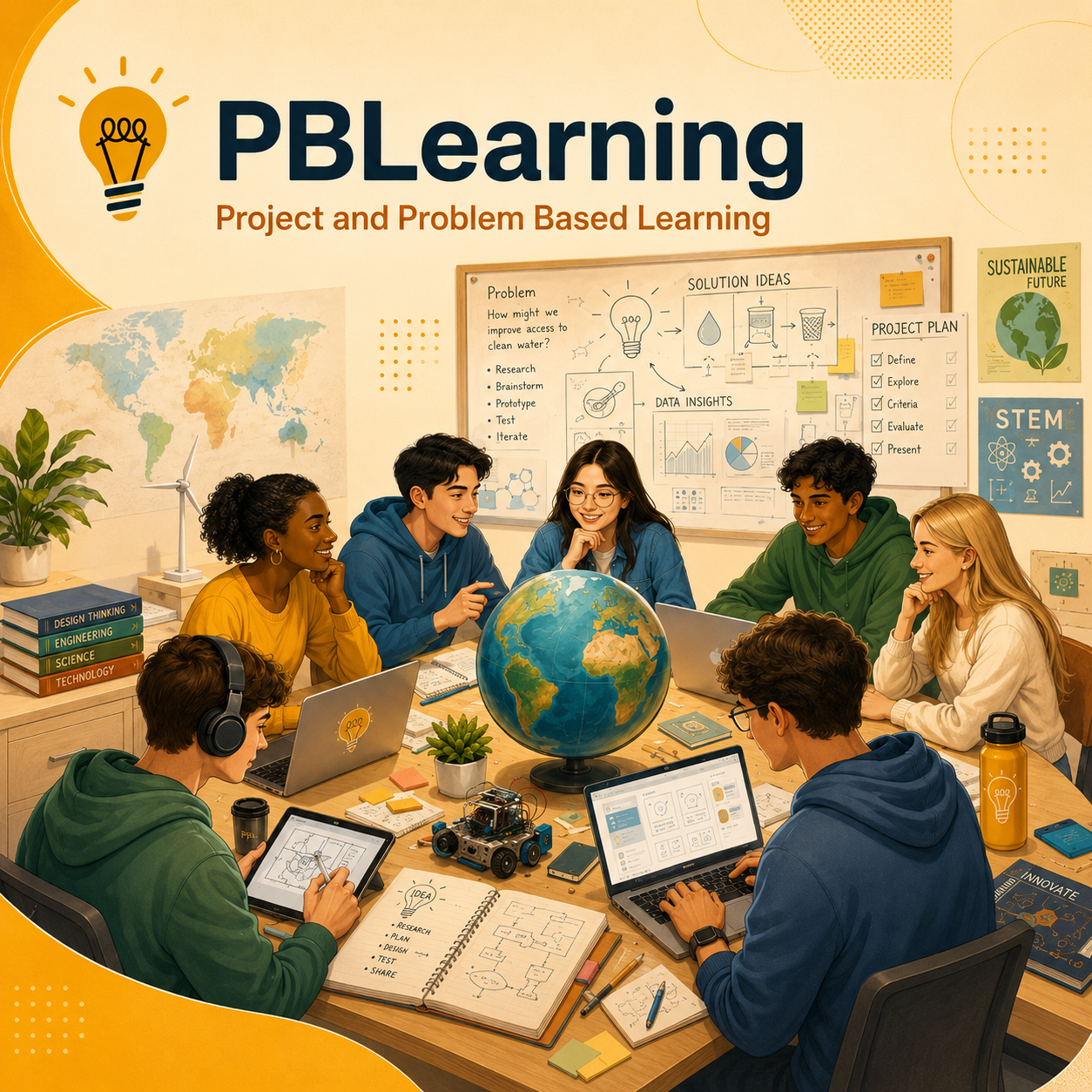
PB Learning is a virtual learning environment (VLE) that helps institutions define, deliver and monitor active learning without imposing a single teaching method. Teachers structure curricula, support collaboration and follow each learner’s progress.
Active curricula designed around real-world problems
Individual achievement monitoring within collaborative work
Assessment and feedback that remain teacher-led
One environment for teaching and learning
Curricula, collaboration, achievement monitoring, and feedback in one place
Explore, learn, synthesise
From individual learning to a shared understanding of the problem.
1. Explore
Understand the situation, discuss prior knowledge, formulate hypotheses and identify what still needs to be learned.
Together, with the tutor
2. Learn
Research, work through resources, experiment and gather evidence of your learning to test the group’s ideas.
Independent study, individually or in small groups
3. Synthesise
Share findings, compare hypotheses with evidence, organise knowledge and return to the original problem.
A shared answer with visible individual learning
Questions still open? Further investigation can inform the synthesis.
Optional extension into a project
Apply / produce
Use this knowledge in a project, a practical outcome or a prototype, with its own milestones, responsibilities and assessment criteria.
A problem-based learning cycle does not require a prototype: project application depends on the learning objectives.
The tutor supports reasoning, helps clarify learning objectives and encourages reflection. The institution’s teaching methods provide the framework for these activities.
Curriculum design and improvement
Problem-Based, Project-Based, and Prototype-Based Learning: three complementary approaches from understanding to making.
Problem-Based Learning
Understand
Students analyze a problem situation, identify what they need to learn, and progressively mobilize the required knowledge.
Project-Based Learning
Collaborate
Students work in teams, share responsibilities, and develop skills around a common objective.
Prototype-Based Learning
Experiment
Ideas become a concrete outcome. Students test, learn from mistakes, and progressively improve their solution.
Collaborative learning
The group is the engine, not the setting
Working together is not one option among others: it is what makes learning happen. Here is why, and how the platform makes it concrete.
Interdependence
The deliverable only exists if everyone brings their part
Clear responsibilities, shared milestones and common deliverables help every learner contribute. The teacher adapts this framework to the needs of the group.
Challenging ideas
Discuss ideas to understand them better
Explaining a hypothesis to the team and considering objections helps clarify reasoning, with guidance from the teacher.
Roles and responsibilities
Organising a team is a skill in itself
Sharing roles, keeping a commitment, settling a disagreement: these are learned by practising them, and they matter as much as the syllabus.
Individual progress
The group erases no one
Contributions, feedback, assessments, and badges stay attached to each student. The group is how they learn, never a way to dilute responsibility.
Explaining, challenging ideas, and producing together make learning visible. The platform gives teachers a framework to support it.
Pedagogical choices grounded in evidence
PB Learning supports approaches documented by research for over fifty years, including both their benefits and their limitations.
A learning platform built by teachers
A method born in medical school
Problem-based learning was formalised in the late 1960s to train practitioners able to reason through a real case, rather than recite a lecture.
Group work only produces its effects when each person's success genuinely depends on the others'. That is what separates a team from a simple division of tasks.
The PBL advantage shows up mainly in long-term retention and skill transfer; it is less clear-cut on immediate recall in standardised exams. A reason to combine it, not to isolate it.
These studies concern teaching approaches. They do not measure the effectiveness of PB Learning itself.
Teaching & Learning
Tools to teach, support, and assess
PB Learning brings curriculum design, achievement monitoring, assessment, and feedback into one environment.
How long does it take to prepare a session?
Reuse your resources or build a first capsule, then define instructions and assessment criteria. Preparation time depends on your starting material; integrated tools avoid software installation to get started.
How do I assess group work fairly?
Set criteria and review each learner’s work, assessments and badges. These records inform your judgment of individual learning within the group project.
Can I write my own courses and projects?
Yes. PB Learning structures your Markdown capsules, learning outcomes, quizzes, and parametric exercises without locking you into imposed content. You remain the author of the learning journey.
You stay in charge
Quizzes and some exercises can be marked automatically using your settings. You choose criteria, interpret results and remain responsible for educational assessment.
Help with preparation
Connect your preferred AI tools to PB Learning
Get help drafting and improving courses, learning capsules, and projects directly within PB Learning’s pedagogical structure.
Build Markdown capsules with learning outcomes, quizzes, and parametric exercises.
Prepare problem-based learning cycles and projects with their phases, resources and assessment criteria.
Read PB Learning guides, validate content, and review proposed changes before applying them.
Your AI tool proposes; the teacher decides
New courses and projects are created as inactive drafts. To edit existing content, the assistant prepares a preview; review it before asking it to apply the changes. A client with write access can save these changes: grant this access only to trusted tools.
1
Your preferred AI tool
2
OAuth-authorized connection
3
Your courses, capsules, and projects
Access is limited by your rights and granted permissions. Requested content is sent to the connected assistant; its data processing terms also apply.
Demo mode
Try it in 30 seconds
Choose a demo tenant and user profile - instant access, no sign-up required.
MySchoolDemo
Achievement monitoring, assessment, and feedback
Collaborative work becomes observable without losing sight of each learner’s individual progress.
The teacher’s role:
The teacher structures the journey, observes team dynamics, provides useful resources, and supports each student’s needs.
Visible team activity
Contributions show how learners explore, compare ideas, and build a response together.
Roles and responsibilities
Clear roles help everyone contribute, take initiative, and understand how the team works.
Milestones and deliverables
Milestones, deliverables, and decisions give the team direction and make collaboration visible.
Individual progress
Contributions, feedback, assessments, and badges document achievement and help every learner improve.
Coding & STEM, from browser to prototype
Write, code, compute, simulate, and test: capsules combine content, assessment, and interactive tools.
Teachers build Markdown capsules with quizzes and parametric exercises. They can embed the tools learners use, with nothing to install and everything running in the browser.
Build learning capsules
Markdown
Structure courses and capsules with text, media, formulae, and diagrams.
Quizzes & parametric exercises
Vary datasets, assess answers, and monitor achievement.
Code & run
Pyodide
Run Python directly in the browser, with nothing to install.
MicroPython
Program, simulate, and connect ESP32, STM32 boards and devices.
Simulate & measure
CircuitJS
Design and simulate electronic circuits in the browser.
Spreadsheet
Work with data, perform calculations, and create charts.
Write & represent
LaTeX
Typeset equations and produce scientific documents.
Typst
Write and compile structured handouts and reports quickly.
DrawJS
Create freehand sketches, schematics, and diagrams.
Hybrid learning and international collaboration
A multilingual environment connecting classrooms and campuses, on site and at a distance.
COIL, BIP, and Internationalisation at Home frameworks
One shared challenge, different contexts and solutions
Synchronous or asynchronous work
Multilingual interface, with explicit education level and collaboration language
Find a partner institution
Specify the level, language, and type of project to prepare a suitable collaboration.
Classes from several institutions can work on the same problem or project while keeping their own teaching organization.
Teams share assumptions, prototypes, and lessons learned to compare approaches.
Milestones and deliverables support coordination across time zones, calendars, and languages.
Shared criteria make outcomes comparable without imposing a single solution on every partner.
Pricing
Open a free Discovery workspace. When you need more, contact us to arrange the right plan and its activation.
Amounts, taxes, scope and renewal are confirmed before purchase. Subscribe online through Stripe where offered, or by quotation and invoice with bank transfer. Stripe is not mandatory for every account. Free signup never starts a paid subscription.
An experiment in one classroom can progressively become a practice shared by colleagues.
1
One class experiments
A teacher launches a first problem, project, or prototype with students.
2
Practices are shared
Colleagues join, reuse resources, and enrich the projects.
3
The institution structures
The school can then support the approach, align practices, and develop collaborations.
A takeover agreed with your institution
Administration or billing takeover is arranged on request after the authorized representatives are verified. Its scope and effective date are confirmed in writing.
Not one more system to administer: PB Learning plugs into your LMS, your identity provider and your team's tools, and lets everyone keep their habits.
Straight from your LMS (LTI 1.3)
The activity opens from a Moodle, Canvas or Blackboard course: learners arrive already signed in, and results flow back into the gradebook with no double entry.
Team code, under version control
Every project team gets its own git repository, generated from a template, with access rights that follow the team roster. Submitting freezes a tag: the record is dated and cannot be edited afterwards.
One identity
Your institution's services can delegate sign-in to PB Learning. One account, one password, and no directory to keep in sync between tools.
Open standards, not bespoke bridges
LTI 1.3 with its grade services, OpenID Connect, Open Badges 2.0 and 3.0, MCP for AI assistants: documented doors that leave you free to walk away with your data.
Frequently asked questions
Before you start
Trial, plans, data and support: prepare your first class.
Discovery is intended for one teacher, one active course and project, and up to 40 students. Try the approach with a class without a payment card or automatic upgrade.
The plan button opens a prefilled enquiry. We confirm scope, amount, applicable taxes, billing period and activation date before you agree. Creating an international profile does not subscribe you to Teacher Plus.
A session is a group of students taking part in the same teaching delivery of a course or project. The number of sessions and the scope of your plan are specified in the order.
Duration, renewal and cancellation terms are confirmed in your offer before purchase. Use the contact form to discuss a change or closure. A free workspace does not commit you to a subscription.
Yes, using an available sign-in provider and a verified academic or professional address. SSO can be discussed later. Email verification alone does not authorize you to bind an institution or process learner data.
If you connect an MCP-compatible assistant, requested content within the authorized scope is sent to it. Choose only the permissions you need and check its provider’s terms. You can revoke access; this does not delete copies already received by that provider.
You define criteria and how results are used. Configured quizzes and exercises may provide automatic marking; educational decisions and learner feedback remain your responsibility.
Yes, on request and after its representative is verified. We confirm scope, administration rights, billing and the effective date. This does not automatically merge content or permissions from other workspaces.
The workspace controller can request return or deletion through the privacy form. We specify formats, timing and backup handling under the DPA. Available open formats do not replace a full workspace return process.
Companion mobile app
Keep learning in class and on the move
The PB Learning app guides learners through their learning paths and keeps progress synchronized with their institution’s workspace.
Read and listen to Markdown learning capsules
Complete multiple-choice quizzes and parametric exercises on mobile
Access learning paths, projects, badges, and upcoming capsules
Secondary education
Extend learning through hands-on work
ABriefCase complements PB Learning with educational kits: a problem, physical equipment, and a team scenario particularly suited to secondary education.